From Paper to Purpose.....
Sustainability Bootcamp Malaysia 2026
The UN framework for sustainability must go beyond knowledge — it needs to take root in the minds, decisions, and everyday actions of young people. But how do we make that happen?
Prelude for the Sustainability Bootcamp – Malaysia 2026

There is a question behind the bootcamp we are building:
It sounds simple. But the more we look at the way children are educated today, the less simple the answer becomes.
Children are surrounded by more information, technology, educational resources and opportunities than previous generations could have imagined. Parents invest heavily in education. Schools continuously develop new programs. Children are encouraged to achieve, compete, perform and prepare for an increasingly complex future.
And yet, something can still be missing.
A child can know a great deal without knowing how to connect that knowledge to reality.
A child can speak confidently without necessarily being able to connect with the people around them.
A child can recite the language of sustainability without understanding what sustainability actually means in everyday decisions.
And a child can become very good at proving that they can do something before they have had enough space to discover what they actually want to do.
That is one of the questions behind this program.
From proving to learning
Much of children’s education is organized around proof.
Prove that you understand.
Prove that you can perform.
Prove that you are good enough.
Prove that you have achieved.
Prove that you are ready for the next level.
There is, of course, a place for achievement and accountability. Children need challenges, standards and opportunities to demonstrate what they have learned.
But development is not the same thing as demonstration.
A child who is still growing needs something else as well:
the freedom to explore.
To try something without already knowing whether it will work.
To make a poor decision and understand why.
To ask a question that may not have an impressive answer.
To fail without interpreting failure as evidence that they themselves are inadequate.
To try again.
The bootcamp is therefore deliberately designed around a different premise.
The purpose is not to create a perfect performance environment for children. It is to create an environment where they can practice becoming capable.
As one of the ideas discussed in developing this program puts it, the bootcamp should be a place for children to “try and fail” before they enter environments where the stakes of failure become much higher.
That distinction matters.
If children are always evaluated by how well they perform, they can eventually learn to protect themselves from failure rather than learn through it.
It tells us what happened.
It gives us something to examine.
It creates another question.
And sometimes, it opens a path that success would never have revealed.
The problem is bigger than the classroom
This is also why we do not see children’s development as the responsibility of schools alone.
A child grows inside an atmosphere.
Parents create part of that atmosphere. Schools create another part. Friends, mentors, communities, businesses, neighborhoods and the wider culture create the rest.
Children observe what adults value.
They observe how adults respond to mistakes.
They observe whether questions are welcomed or dismissed.
They observe whether success is celebrated while failure is hidden.
They observe whether sustainability is something people genuinely practice or simply something printed on a poster.
This is why the program cannot be reduced to a curriculum.
We are interested in the environment surrounding the child.
That is why parents are not expected to simply drop their children at the bootcamp and return when the activity is over.
The intention is for parents and children to learn together.
The learning should have somewhere to go when the bootcamp ends.
It should return home.
It should enter everyday decisions.
It should become part of the atmosphere in which the child continues to grow.
At first glance, sustainability might seem like a straightforward topic for children: Reduce. – Reuse. – Recycle.
Save water.
Save electricity.
Don’t waste food.
These are important messages. But they can become surprisingly shallow when children learn them only as instructions.
Ask a child what sustainability means and they may quickly produce the correct answer.
But ask:
Why?
Why are we wasting this?
Why are we buying this?
Why do we need more?
Why does this product exist?
Why does this business operate this way?
Why do people behave differently from what sustainability campaigns tell them?
The answers become much harder.
That is where our understanding of sustainability begins to expand.
Perhaps sustainability is not only about whether we waste water or plastic.
Perhaps we also need to ask whether we waste time.
Whether we waste talent.
Whether we waste potential.
Whether we waste opportunities.
Whether we waste our ability to connect with other people.
This is an important shift in the program
We are trying to move sustainability from a list of environmental behaviors into a way of thinking about value, resources, choices, relationships and consequences.
The sustainability paradox
There is an even deeper question.
We live in an economic system that often rewards consumption.
Buy more because the unit price is cheaper.
Replace something because a newer version exists.
Produce more because future demand is projected.
Keep inventory because inventory supports sales.
Discount excess products when they do not move.
And then, at the same time, tell children:
Do not consume too much. Do not waste. Be sustainable.
This creates a paradox.
Imagine that you only need one litre of yogurt.
The supermarket offers three litres for a lower price.
Buying three may be economically attractive.
But you still only needed one.
You saved money while acquiring more than you needed.
This is the kind of contradiction we want children to learn to see.
The sustainability discussion in our program therefore goes beyond products and recycling. It asks children to look at the systems behind consumption: inventory, incentives, habits, expectations, business models and human decisions.
The goal is not to give children a predetermined answer.
The goal is to teach them to notice the contradiction and ask better questions.
From SDG knowledge to SDG inquiry
The Sustainable Development Goals give us an important common language.
Children need to understand what the SDGs are.
But knowing the SDGs is only the beginning.
We do not want children to walk into a shop, take a photograph of some rubbish and say:
“This is not sustainable.”
That is observation at the surface.
We want to ask them to go deeper.
What is happening here?
Why is it happening?
Who is involved?
What does the customer expect?
What does the business prioritize?
What decisions created this situation?
What incentives are influencing those decisions?
Where does sustainability exist in the mindset of the people involved?
And perhaps the most interesting question:
What would you change?
This turns the SDGs from something children memorize into a lens through which they investigate the real world.
The child moves from identifying a problem to understanding a system.
That is a very different kind of learning.
A program built as a journey
The bootcamp is built around four connected areas:
Leadership.
Daily Discovery.
Sustainability.
Entrepreneurship.
These are not intended to function as four separate subjects.
We are not looking for organizations simply to send children to a program.
We are not looking to hand over a kit and say, “Here are the instructions. Good luck.”
The program is developing training materials and a sustainability kit to help partners understand the concepts, activities and educational objectives. But the kit is intended to support training and collaboration, not replace it.
Partners are expected to understand the philosophy, participate in preparation, contribute their own context and help create continuity around the children.
In other words:
The partnership begins when we ask: What can we build together that would be meaningful for your children and your community?
What we are still learning
This program is not presented as a finished formula.
We have previous experiences to learn from, including sustainability bootcamps conducted in different locations and years. Those experiences give us examples, observations, photographs, activities and stories that inform what we are building now.
But every new group of children brings new questions.
We want to understand:
How deeply can children reinterpret sustainability?
What happens when they encounter the same idea in different environments?
How do their questions change?
What do they notice after the first observation, and what do they notice after the second or third?
How does peer influence shape participation?
What happens when parents carry the learning home?
What can children see in a business or community that adults have learned to overlook?
These questions are not separate from the program.
They are part of the program.
The larger ambition
To ask where implementation has failed.
To identify contradictions.
To examine the systems behind the problems.
To listen to different perspectives.
To form their own arguments.
And eventually, perhaps, to stand in front of institutions much larger than themselves and ask difficult questions about the world they are inheriting.
That is a very different definition of a global citizen.
A global citizen is not simply someone who knows what the world looks like.
It is someone who can see, question, connect, participate and contribute.
And perhaps that begins with giving children something increasingly difficult to find:
the permission to explore before they are asked to prove.
Kids are meant to explore, not to prove.
That is where this bootcamp begins.
View the Brochure below for more details…
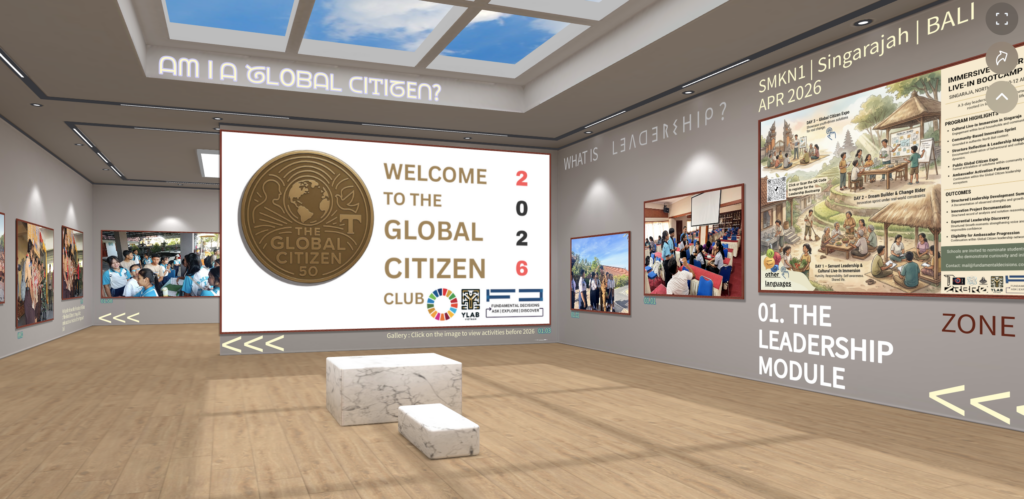
Visit Our Global Citizen Gallery – 2026
We are in the process of building this up. Please click on image to view our work in progress for the year.